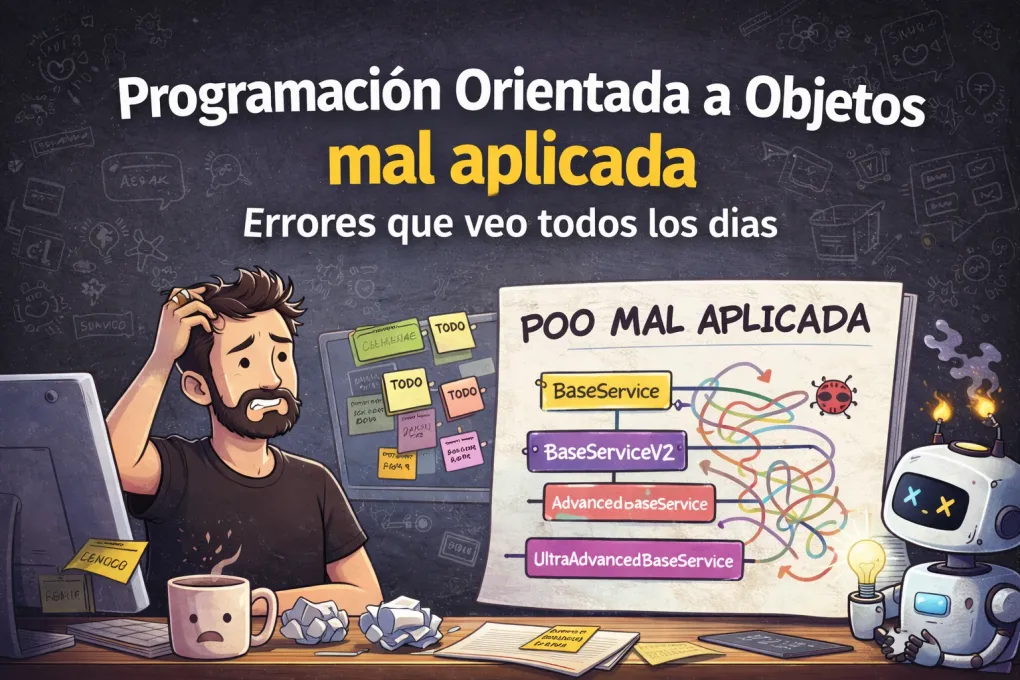
Object-Oriented Programming done wrong
Common OOP mistakes I see every day
Object-Oriented Programming done wrong: mistakes I see every day
Object-Oriented Programming isn’t bad. The problem is how we use it.
After years working in backend, reviewing code from other teams, and diving into systems that have been in production for years, I’ve seen the same mistakes over and over.
And they almost always come from understanding OOP as theory, not as design.
Let’s talk plainly.
Mistake #1: Classes that do everything
This is the classic one.
Giant classes that:
- validate
- call the database
- process logic
- send emails
- write logs
- do everything but make coffee
All in one class.
This breaks the most basic idea of OOP:
one class = one clear responsibility
When a class does everything:
- it’s hard to test
- it’s scary to touch
- any change breaks something
If a class scares you to open… you know something’s wrong.
Mistake #2: Thinking more classes = better design
Some people discover Clean Architecture and suddenly the project has:
- 200 interfaces
- 300 folders
- super long names
- zero clarity
OOP is not about creating classes for the sake of creating classes.
Good design:
- is understood quickly
- has few pieces
- each piece makes sense
If you need a map to understand your own project… you’re overengineering.
Mistake #3: Inheritance for everything
Inheritance is one of the most abused concepts.
Typical example:
BaseServiceBaseServiceV2AdvancedBaseServiceUltraAdvancedBaseService
This creates:
- fragile hierarchies
- invisible dependencies
- hard-to-track bugs
Nowadays, composition > inheritance in most cases.
Key question:
Does this really is a type of that, or does it just use that?
Mistake #4: Objects without behavior (data only)
This is very common in backend.
Classes that only have:
- properties
- getters
- setters
And all the logic lives in giant services.
That’s not OOP. That’s procedural programming in disguise.
An object should:
- know its rules
- protect its state
- validate its own consistency
If your objects don’t do anything… something’s wrong.
Mistake #5: Coupling everything to frameworks
This one hurts.
Classes that depend directly on:
- Entity Framework
- external libraries
- infrastructure
When you mix:
- domain
- infrastructure
- framework
you lose:
- testability
- flexibility
- design control
Well-applied OOP protects your domain, it doesn’t expose it.
The problem isn’t OOP, it’s how we think
Most of these mistakes don’t come from bad intentions. They come from:
- copying examples
- following tutorials without context
- applying patterns without understanding the problem
OOP isn’t about memorizing concepts. It’s about making conscious decisions.
A simple rule that helps a lot
Before creating a class, ask yourself:
- what responsibility does it have?
- what should it NOT do?
- who uses it?
- what would happen if it changes tomorrow?
If you can’t answer that… wait.
Wrapping up…
Well-applied OOP:
- makes code clearer
- makes changes easier
- reduces bugs
- makes the team happy
Poorly applied:
- creates monsters
- slows down development
- burns out engineers
In upcoming blogs I’ll dive into:
- real C# examples
- how to design useful objects
- when NOT to use OOP
This is just the beginning.
Let’s keep going!
Share this post