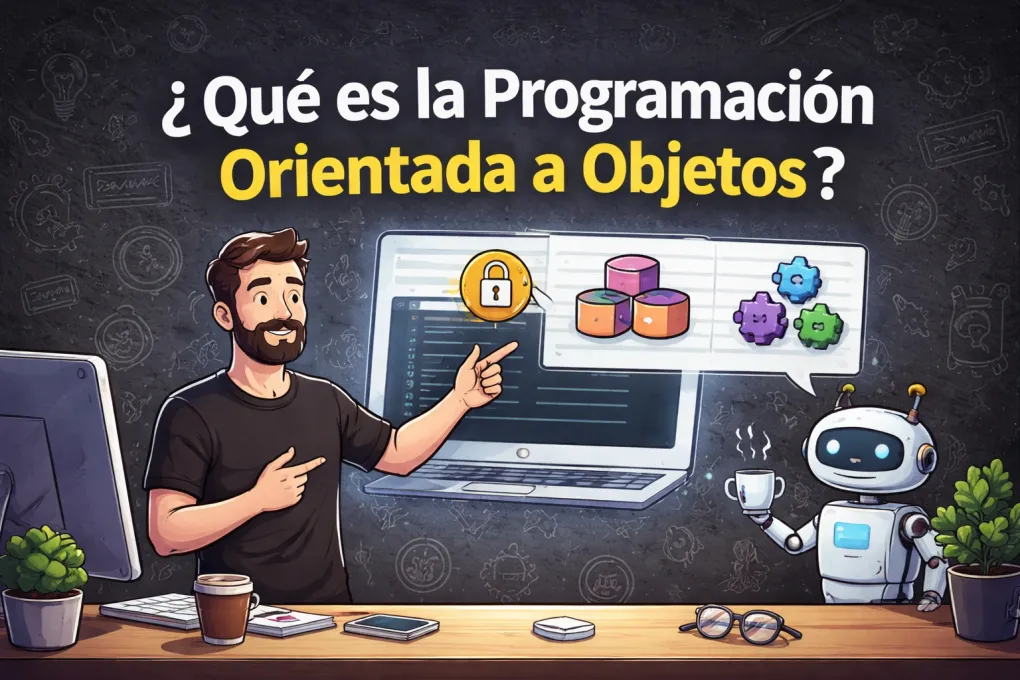
Object-Oriented Programming
A clear explanation of OOP without complicated jargon
What is Object-Oriented Programming? (explained without complications)
If you’re just starting out in programming (or you’ve been at it for a while but this never clicked), you’ve probably heard the term Object-Oriented Programming or simply OOP a thousand times.
And it’s also likely that after reading definitions like:
“It’s a paradigm based on classes, objects, inheritance, polymorphism, and encapsulation…”
you ended up just as confused or worse. So let’s talk plainly.
First: why does Object-Oriented Programming exist?
OOP wasn’t born to make our lives harder. It was born because code became large, complex, and difficult to maintain.
At first, programs were small:
- functions
- variables
- one file
- everything worked
But when systems grew:
- more rules
- more people working
- more changes
the code became a tangled mess.
Object-Oriented Programming tries to solve this with a simple idea:
Model software like real-world things, each with its own responsibility.
So… what is an object?
An object is simply:
- something that has data
- and can do things
For example, think of a User.
A user:
- has a name
- has an email
- has a password (hopefully hashed)
- can register
- can log in
In OOP, that User becomes an object.
And what is a class?
A class is the blueprint, the mold, the recipe. If the object is the car you drive, the class is the car’s design.
Mental example:
- Class:
User - Objects: John, Maria, Peter
They’re all users, but each with different data.
The 4 concepts they always mention (but rarely explain well)
1. Encapsulation
It’s a fancy way of saying:
“Don’t expose what doesn’t need to be exposed.”
An object should protect its internal state and let others interact with it only through what it allows.
This prevents:
- accidental changes
- fragile dependencies
- hard-to-track bugs
2. Abstraction
To abstract is to keep what’s important and hide what’s irrelevant.
When you use a car:
- you don’t think about the engine
- you don’t think about combustion
- you just drive
In code, it’s the same:
- you use what you need
- without knowing how it’s implemented inside
3. Inheritance
Inheritance allows a class to reuse behavior from another.
But be careful! Misused inheritance creates more problems than solutions.
Nowadays:
- it’s used less
- composition is preferred
But it’s still important to understand it.
4. Polymorphism
It sounds complicated, but the idea is simple:
Different objects can respond differently to the same message.
This allows:
- more flexible code
- fewer
if/elsestatements - extensible systems
OOP is NOT the solution to everything
And this is important to say from the first blog post:
Object-Oriented Programming:
- is not perfect
- doesn’t apply equally to all problems
- is not always the best option
Nowadays we use:
- functional programming
- hybrid approaches
- event-driven architecture
But understanding OOP remains key, especially in:
- C#
- Java
- enterprise systems
- modern backend
The most important idea you should take away
If you only remember one thing from this article, let it be this:
OOP isn’t about classes, it’s about responsibilities.
When you think about objects, ask yourself:
- what does it do?
- what is it responsible for?
- what should it NOT do?
If you do that right, the rest falls into place.
Wrapping up…
This blog is the first in a series where I’ll talk about:
- modern C#
- real backend
- architecture without smoke and mirrors
- common mistakes I see every day
If you’re just starting out or want to level up, stick around.
Let’s go step by step!